
Overview
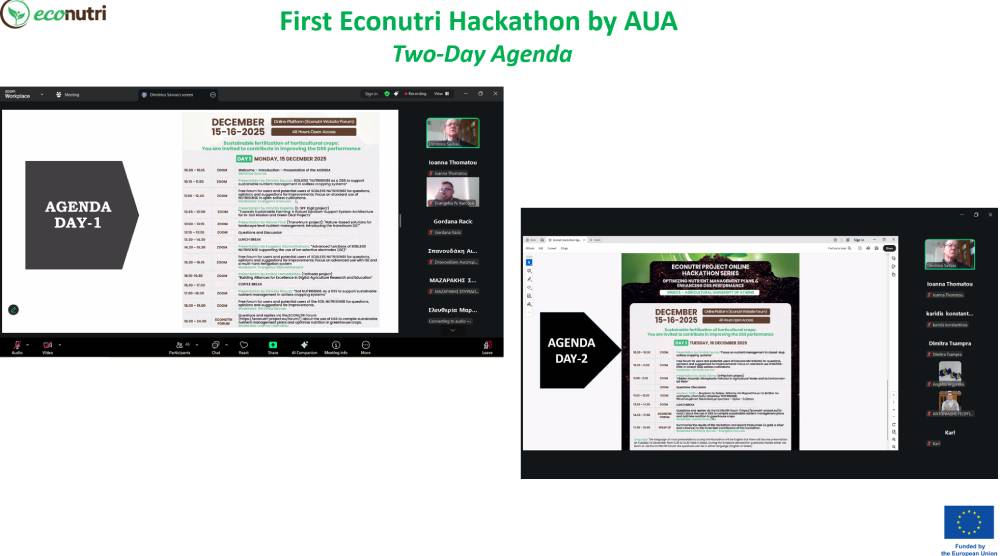
The ECONUTRI Online Hackathon, held on 15–16 December 2025 and hosted by the Agricultural University of Athens (AUA), brought together farmers, researchers, advisors, students and technology developers from across Europe. The two-day event aimed to advance sustainable nutrient and water management by showcasing and stress-testing decision support systems (DSS), collecting user feedback, and fostering cross-project collaboration.
A central focus throughout the hackathon was NutriSense, the ECONUTRI decision support system for nutrient management in soilless and soil-grown crops, alongside complementary tools and approaches from sister Horizon Europe projects.
Day 1 – Decision Support Systems for Nutrient Management
Day 1 focused on the technical foundations of nutrient management DSSs, with live demonstrations and in-depth presentations.
- NutriSense DSS (ECONUTRI) was presented by Prof. Dimitrios Savvas, covering both open and closed systems in soilless and soil-based cultivation. Participants followed step-by-step demonstrations on how to:
- Input water and drainage analysis data,
- Adjust nutrient solutions based on crop needs and drainage results,
- Design starter and customised nutrient recipes, and
- Interpret results to reduce nutrient losses and environmental impact.
- Advanced discussions addressed hydroponic nutrient strategies, pH adjustment (with emphasis on nitric acid), water quality considerations, and the importance of accurate analytical data.
- Automated nutrient management was showcased through the use of ion-selective electrodes (ISEs) integrated with NutriSense, highlighting improved nutrient use efficiency, water productivity, and crop performance.
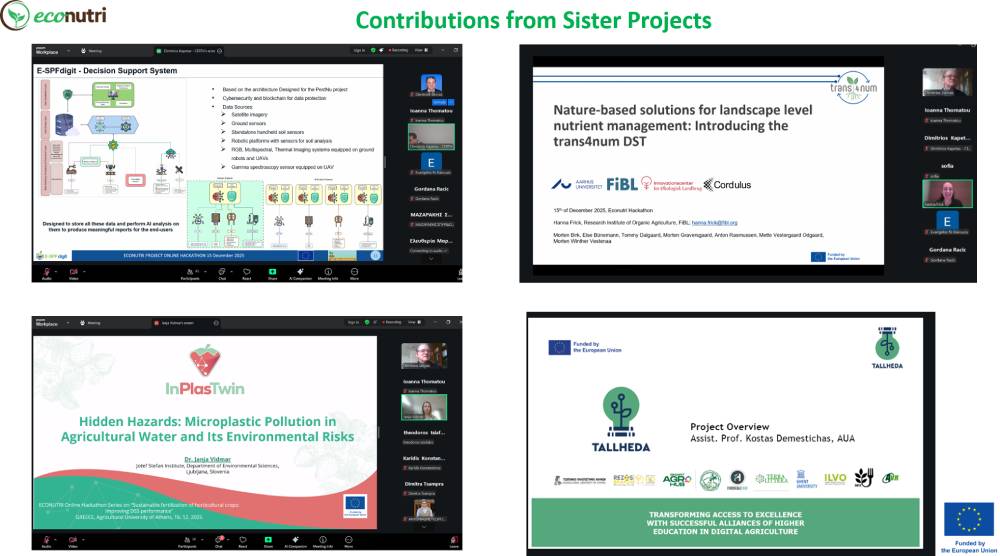
Contributions from Sister Projects
- E-SPF Digit introduced digital tools for soil and plant health, including robotics, IoT devices, AI-driven models, and secure data infrastructures.
- Trans4num presented a landscape-level DSS based on nature-based solutions to reduce nutrient pollution while maintaining economic viability.
- Tallheda highlighted cross-disciplinary research linking agriculture and computer science, with a focus on AI, data analytics, and digital twins.
The day concluded with an active Q&A session and open discussion, where participants provided concrete suggestions for improving NutriSense functionality, sensor integration, and accessibility.
Day 2 – Applied Nutrient Management & Emerging Challenges
Day 2 shifted towards applied nutrient management challenges in horticulture, recycling strategies, and emerging environmental risks.
- Detailed discussions explored open vs. closed soilless systems, sodium accumulation, recycling of drainage solutions, and practical strategies for maintaining optimal root-zone conditions.
- API-based communication between fertigation systems and NutriSense was demonstrated, highlighting pathways towards automation and reduced manual data entry.
- A dedicated session addressed microplastic pollution in agricultural systems, presented within the framework of the InPlasTwin project. The presentation focused on:
- Pathways of micro- and nanoplastics into agriculture,
- Impacts on soil, crops, and water,
- Ongoing experiments in strawberries under soilless and soil-based systems, and
- The need for improved analytical methods and long-term monitoring.
Participants discussed future enhancements, including:
- AI-supported correction of sensor inaccuracies,
- Automatic extraction of laboratory data from reports,
- Improved offline and low-connectivity solutions for DSS users.
Awards & Recognition
The hackathon concluded with the recognition of participants who made technical and conceptual contributions:
🥇 1st Prize: Ioannis Glykos
🥈 2nd Prize: Savvas Lergos
🥉 3rd Prize: Talha Chaudhary
All participants were invited to receive certificates of participation, reinforcing the collaborative and inclusive spirit of the event.
The ECONUTRI team thanks all speakers, contributors, and participants for making this hackathon a success and looks forward to continuing the journey toward smarter, data-driven, and environmentally responsible agriculture.
Photos